
Managing Beyond Your Scope
Don't be a backseat driver, help clear the road.

Imagine you’re Reed Hastings, CEO of Netflix, at the moment the company has decided to embrace producing content. To this point, the company’s edge has been in deploying video streaming at scale, a problem squarely in the realm of computer science. But now the company is going to try to produce compelling content, something which would require totally new teams and ways of thinking. Very quickly, Reed will have teams producing TV and movie content reporting up the chain to him and he will have to provide some level of guidance.
Similarly, I recently coached a founder of startup who decided to hire a VP of engineering. This VP was older and more experienced than him. The founder I was coaching voiced his concern like this:
“How I am supposed to provide guidance and ‘lead’ someone who knows better than I do what the right steps are?”.
It’s really not much different than the situation Reed Hastings was in. Is Reed supposed to know which movie projects to approve?
Here’s how I coach people in these predicaments.
Set objectives, clear roadblocks
The first realization is that it’s not your job in such situations to supervise or even add value to the output of leaders working under you. Do you think it was Reed’s job to review and offer comments to the script to House of Cards? Of course not.
As outlined in his own words in his book No Rules Rules, Reed set high-level objectives. In this case, the objective was to take risks for the purposes of learning as much as possible. He was fine with failing as long as learning came back to the company. He went so far as to demonstrate how he failed and learned from his actions. He also knew that a taking those kinds of risks would require him to remove roadblocks, which he did through cleverly removing barriers in the org. The combination of hiring smart people and empowering them was enough to ensure success.
I’m reminded here of Steve Jobs’ quote:
“It doesn’t make sense to hire smart people and tell them what to do; we hire smart people so they can tell us what to do.” —Steve Jobs
Know the stages
Usually when executives are unsure how to “manage” someone, it is well intentioned. They want to help. The problem is, the way the have historically helped their direct reports is by reviewing or even co-working on a problem.
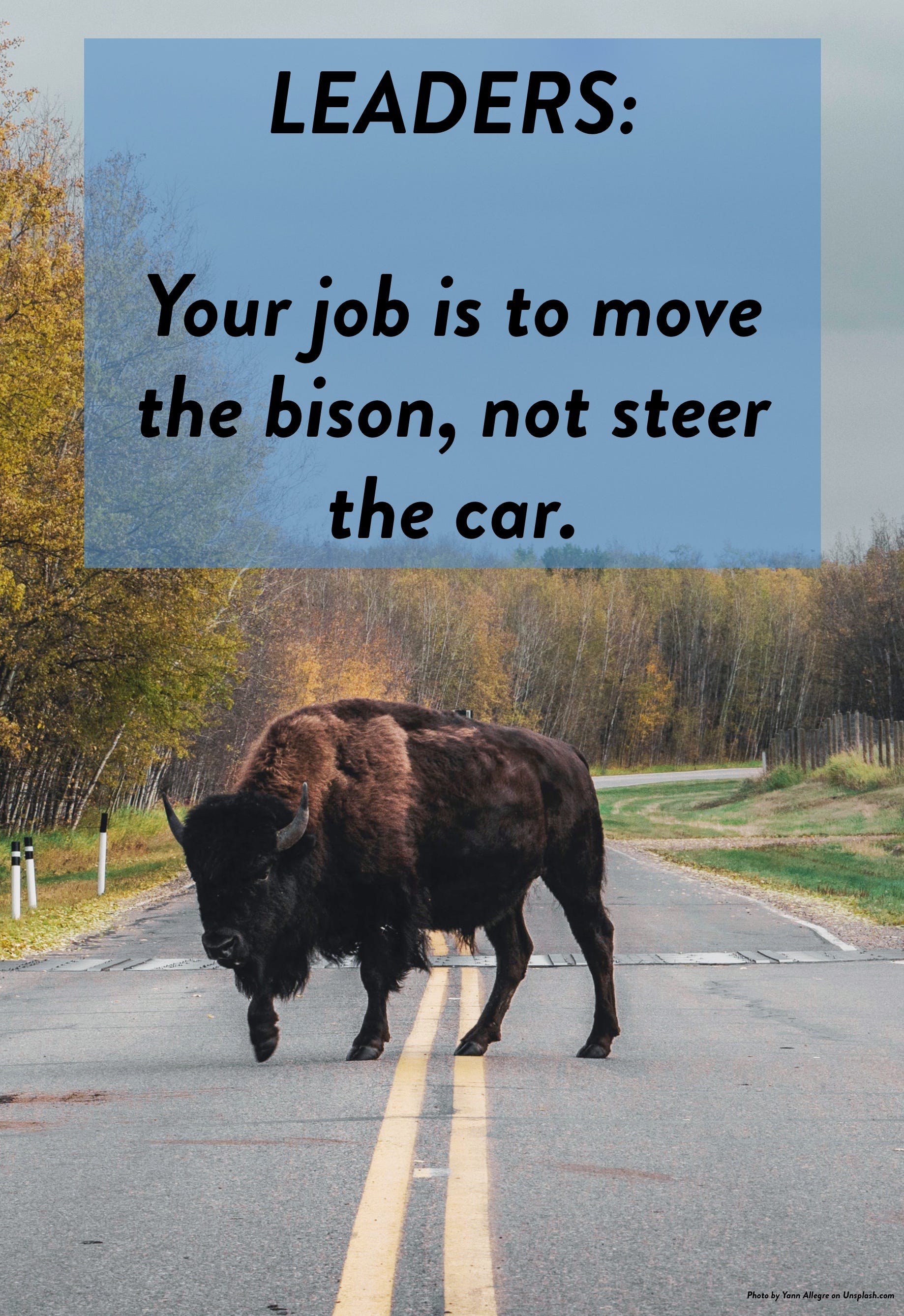
The solution here is to understand the four stages of development. The stages are contributing, managing leading and finally representing. While managing is directly supervising and helping, leadership means creating the environment where your talent can be successful. Ask your reports what organizational roadblocks they face, then go fix them! Instead of being a backseat driver, get out of the car and clear the road:
Keep them honest to their own plans
I remember a lightbulb moment in my own career when I was asked to prepare a presentation for some executives at Qualcomm. The request was to include some implementation details for a new proposed product. At first I was frustrated with the request. Why would executives need to concern themselves with implementation details? Then I started writing the slides. I realized that some of the product details were not clear in my own head. I had several valuable conversations with my peers and cleared it up. I realized something important: The request for details by the executives had forced me to organize my own thoughts.
In other words, as a leader sometimes all you need to do is ask those under you to be prepared to explain their plan or product. The work done to create the plan and present is itself the valuable exercise. The actual presentation is often an anti-climax, which is perfectly fine. I remember preparing a slide deck of 50 slides, ready for any contingency. In the end, the actual meeting used 6 of those slides. But the preparation was valuable.
Build a company or build a product?
A successful startup founder must explore how much passion they have for building a company versus building a product. Sergey and Larry, for example, brought on Eric Schmidt as CEO because in part they realized their skills and appetite for running a company wasn’t on-par with building technology. By contrast Reed Hastings of Netflix shows an appetite and aptitude for building great cultures and teams. Neither is right or wrong, it’s a question of achieving clarity and executing.
Asking the right questions and getting clear on what you want and what the team needs is the the way to achieve personal and company success.
Some great pointers!
Insightful as always, Paul!